Best Online Casino Game Shows in the UK
 Available in GB
See how presenters, studio sets, streamed video and big-wheel formats create a more theatrical online casino experience.
What Makes a Casino Game Show a Live Experience?
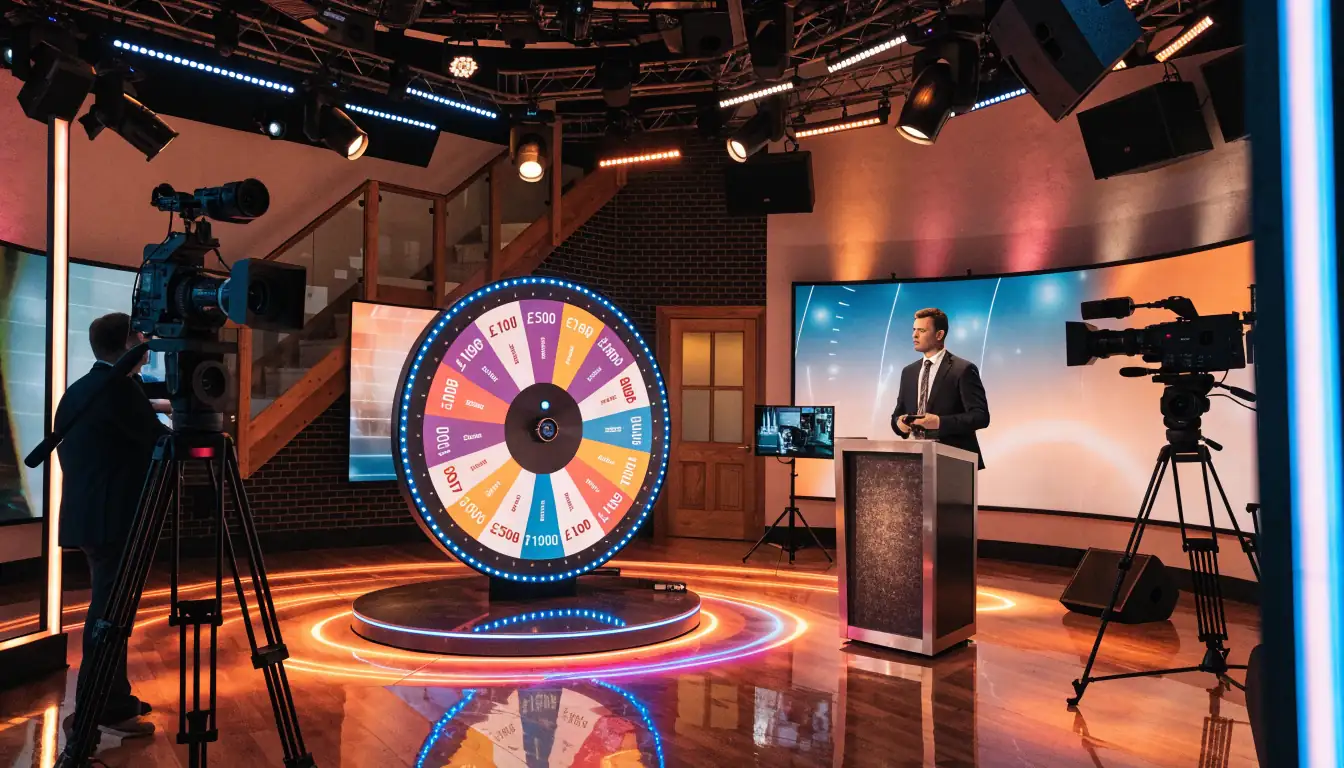
A live casino game show borrows the grammar of television and places a wager inside it. There is a studio, a presenter, a set designed to be seen rather than merely used, and a video feed carrying the action to a screen. The result is neither a conventional casino table nor a television programme in the old passive sense. It is a game with a stage.
That distinction matters. Standard online casino games are generally interfaces first: reels, cards, buttons, prompts and animations arranged for quick interaction. A live game-show casino format makes the human presentation part of the product. The host announces the round, explains what is happening and gives the sequence a beginning and an end. Even when the underlying rules are simple, the delivery creates an occasion.
The studio is part of the game
In a conventional digital game, the visual world is usually generated by software. A live casino game show instead presents a physical environment through streamed video. Cameras show the wheel, table or other equipment; lighting marks the set as a performance space; graphics identify outcomes and actions as they occur.

This does not make the result less regulated or less mechanical. It changes where the sense of presence comes from. The player is not watching a fictional dealer rendered by an animation engine but a broadcast from a studio in which a presenter is conducting the round. The small details of live production—pauses, gestures, announcements and the rhythm between rounds—become part of the experience.
Television has always understood this trick. A studio audience need not be visible for a programme to feel public. The camera implies a room beyond the frame. Live casino game shows use the same implication, although the room has been reorganised around betting.
A host gives the round a social rhythm
The presenter is more than decoration. A host explains the rules, handles the transitions and keeps the game legible while several outcomes or features may be in play. In a digital slot, the software can move directly from one spin to the next. In a hosted format, the presenter creates a pause before the result and a recognisable rhythm after it.

That rhythm is one reason these games can feel closer to entertainment programming than to a silent casino interface. The host acknowledges the result, maintains continuity and turns a sequence of random events into something that resembles a shared broadcast. The social element remains mediated: there is no guarantee of personal conversation or a real relationship with the presenter. Still, the visible human presence changes the emotional temperature of the round.
The distinction is modest but powerful. A button says “start.” A host says, in effect, that the next moment is about to happen.
Streaming interaction without changing chance
A live game show may display chat, player activity, bet selections or other interface information alongside the video. These features can create the impression of a communal room, especially when multiple people appear to be participating at the same time. They show the activity surrounding the game, not a private game being played against a hidden opponent.

The streamed presentation also needs to be separated from the source of randomness. For games using randomised outcomes, certified RNG software is used to deliver those outcomes. Independent testing laboratories such as eCOGRA, iTech Labs and GLI check whether RNG results are random and unbiased and whether they correspond with the published RTP. The studio, the presenter and the broadcast add atmosphere; they do not turn chance into judgement.
This is an important boundary in a format built to look immediate and personal. A host may reveal an outcome in real time, but the performance does not mean the result has been chosen for the audience. The drama is in the reveal, not in a human decision about who should win.
Game mechanics beneath the presentation
The visible show can vary considerably, while the basic mechanics remain familiar. A round may involve a wheel, cards, numbers or another defined sequence. The software records the relevant selections and settles the outcome according to the published rules. Features, multipliers or bonus stages may add more steps, but they remain components of the game’s design rather than spontaneous acts by the studio staff.
Created by the studio, professional cameras, and high-quality graphics.
Supplied by the host’s introductions, pauses, and the reveal of outcomes.
Focused on the underlying rules, software, and the technical result.
Clear rules and RTP information are required for UK-facing game providers. That requirement is especially significant when entertainment design might otherwise distract from the mathematics. A colourful set cannot replace an explanation of how a round works. Nor can the apparent liveliness of a broadcast change the long-run return built into the game.
Fairness is therefore present in two layers. The first is technical: the outcome system must operate as described and satisfy the applicable standards. The second is communicative: the rules and RTP must be available in a form that allows the game to be understood. Spectacle is welcome. Mystery is not.
Why the format feels different
The live casino game show format combines three kinds of attention:
- Visual attention, created by the studio, cameras and graphics.
- Narrative attention, supplied by the host’s introduction, pause and reveal.
- Mechanical attention, focused on the rules and the outcome.
Traditional casino games can contain all three, but online versions often place the mechanical layer first. A hosted show reverses the emphasis. The game is still a gambling product, yet it is packaged as an event with a presenter and a broadcast identity.
That packaging helps explain its appeal without pretending that entertainment changes probability. The format gives solitary screen activity a public shape. It borrows the familiarity of a quiz show, a studio contest or a televised draw, then attaches a casino mechanism to the sequence. A remarkably old idea in a remarkably polished jacket.
In the United Kingdom, gambling is available only to people aged 18 and over. UK-facing providers must also meet technical standards for fairness and security, while providers offering content to British players must hold the relevant UK Gambling Commission position themselves or work with licensed operators. The show may look informal; its obligations are not.
What makes the experience live, then, is not merely that a camera is switched on. It is the combination of real-time presentation, human hosting, visible production and immediate settlement around a defined game. The screen becomes a small studio, the round becomes a broadcast moment, and the underlying mathematics continues quietly beneath the applause.
The Studios Behind Online Casino Game Shows
This page provides a clear starting point for exploring online casino game shows in the UK in 2026. Use the key details below to identify which options match your preferences for bonuses, withdrawals and minimum deposits.
License: UKGC Operator Licence · Bonus: £200 welcome bonus · Payout speed: Within 48 hours · Min. deposit: £10 32Red holds a UKGC Operator Licence and offers a £200 welcome bonus. Its minimum deposit is £10, with payouts processed within 48 hours.
License: UKGC Operator Licence · Bonus: £100 bonus · Payout speed: Within 24 hours · Min. deposit: £10 ProgressPlay Limited operates under a UKGC Operator Licence and offers a £100 bonus. Players can deposit from £10, with payouts available within 24 hours.
License: UKGC Operator Licence · Bonus: £100 bonus · Payout speed: Within 24 hours · Min. deposit: £10 Genesis Global Limited is covered by a UKGC Operator Licence and offers a £100 bonus. The minimum deposit is £10, and payouts are processed within 24 hours.
License: UKGC Operator Licence · Bonus: £100 bonus · Payout speed: Within 24 hours · Min. deposit: £10 LeoVegas holds a UKGC Operator Licence and provides a £100 bonus. It accepts minimum deposits of £10 and offers payouts within 24 hours.
License: UKGC Operator Licence · Bonus: £20 bonus · Payout speed: Within 48 hours · Min. deposit: £10 Silverbond Enterprises operates with a UKGC Operator Licence and offers a £20 bonus. The minimum deposit is £10, while payouts are processed within 48 hours.
License: UKGC Operator Licence · Bonus: £50 bonus · Payout speed: Within 48 hours · Min. deposit: £10 Platinum Gaming Limited holds a UKGC Operator Licence and offers a £50 bonus. Players can deposit from £10, with payouts processed within 48 hours.
The casino brand on the screen is rarely the company that created the game. Behind an online game-show table sits a specialist game provider: a business responsible for the format, software, presentation, technical operation and distribution of the content. The casino supplies the public-facing account. The provider supplies much of what makes the experience recognisable.
That distinction matters when comparing live casino game shows in the UK. A familiar logo on a casino website does not tell the whole story. The same platform may host content from several providers, each with its own visual language, pace and approach to interaction. One studio may favour a polished television set and a large presenter-led spectacle; another may make the rules feel more compact and functional. The catalogue is not a single genre in any meaningful artistic sense. It is a meeting place for different production systems.
What a game provider actually supplies
A game provider develops the casino game and prepares the software through which it is delivered. For a live game show, that work extends beyond a title and a set of rules. It includes the digital interface, the connection between the streamed studio and the betting screen, the handling of game states, the display of results and the systems that allow many players to participate at once.
The provider then has the game independently tested and certified for fairness by third-party testing houses before licensing it to casino operators. This arrangement separates three jobs that are easy to confuse:
- the provider creates and distributes the game;
- an independent testing house examines fairness and technical performance;
- the casino operator presents the finished content within its own website or app.
The separation is useful. A casino brand can offer a substantial library without building every title itself. A provider can distribute its catalogue to more than one operator without becoming a gambling website in the consumer-facing sense. The public sees one lobby; the industry sees a chain of contracts, integrations and compliance responsibilities.
In a live game show, the studio element gives the product a more theatrical surface, but the underlying software remains decisive. It must connect the broadcast, the game rules and the account activity without treating any of those as an afterthought. A presenter can create atmosphere; the platform still has to register the relevant game events correctly.
How content reaches a UK-facing casino
The route from studio to player is not a simple upload. Providers license their games to casino operators, and operators pay to host that content on their platforms while providers receive a revenue share. The commercial arrangement explains why a single title may appear in several casino lobbies while remaining recognisably the same production.
Integration is the quiet labour behind the visible catalogue. A casino must connect games to its account, payment, and compliance systems.
A platform advertising games from several providers has licensing agreements with those studios and has integrated their catalogues into its service, according to a specialist industry review. Integration is the quiet labour behind the visible catalogue. The casino must make the game available in its lobby, connect it to account and payment systems, support the relevant technical standards and place it within its compliance framework.
This is why “available at a casino” does not mean “made by the casino”. The operator curates and hosts the content; it does not thereby become the author of the format. A casino can choose which providers to include, how to organise the lobby and which promotions to attach to the games. The game’s core presentation and mechanics remain tied to the provider’s software.
The commercial relationship can also affect how content appears. A specialist industry review reports that some casino-provider arrangements offer early access or exclusive releases. Such an arrangement is a contractual feature, not a universal property of live game shows. It may make one catalogue look fresher or more distinctive on a particular platform, but exclusivity should not be confused with a different fairness standard or a different underlying category of game.
Why one studio does not feel like another
Different game studios are associated with different volatility profiles and gameplay styles, according to a specialist industry review. The observation is less mysterious than the language can make it sound. Volatility describes the shape of outcomes over play, while gameplay style covers the pace, structure, presentation and decisions built into the format. These qualities are designed into the product rather than added by the casino hosting it.
For live game shows, style can be felt in several places:
- the speed at which rounds move;
- the amount of presenter commentary;
- the use of bonus stages or feature segments;
- the visual density of the interface;
- the way results and potential outcomes are displayed;
- the balance between a television-like set and a functional betting screen.
Two games can both be described as live casino game shows and still create different moods. One may feel like a studio programme with a betting layer attached. Another may feel like a casino game that borrows the grammar of television. Neither description determines whether a player will prefer it. It does explain why a catalogue assembled from several providers rarely feels uniform.
The distinction between style and fairness is important. A dramatic set, animated graphics or a lively host changes the experience of watching a round. It does not, by itself, establish a better mathematical outcome. A provider’s production values are visible; the fairness certification is a separate matter.
Testing, certification and UK regulation
Game providers offering content to UK players must be licensed by the UK Gambling Commission or work with operators that are licensed. UK-facing providers must meet technical standards for fairness and security. Those obligations apply to the software supply chain, not merely to the casino’s front page.
UK Regulation
Gambling is available only to people aged 18 and over. Providers must meet strict UKGC technical standards for fairness and security.
Independent testing laboratories, including eCOGRA, iTech Labs and GLI, examine whether random outcomes are unbiased and whether they match the published RTP where RTP is applicable. They are not ornamental badges placed beside a game after the creative work is finished. Their role is to test the technical claims on which the product depends.
For a slot, the process is relatively easy to describe: the RNG generates a result, the game engine maps it to symbols and a payout, and each spin is independent of the last. Live game shows can involve streamed studio presentation and game-specific event logic, so their visible operation differs from a conventional slot. The central principle remains that the software must operate according to documented rules and approved technical requirements.
Clear game rules and RTP information must be available for UK-facing casino content. The information gives the format a defined frame, even when the production is deliberately exuberant. A presenter may invite suspense. The rules still have to say what the game does.
The UK Gambling Commission’s role sits above the individual title. Operators providing online gambling services to consumers in Great Britain must hold a UKGC licence regardless of where they are based, and a remote operating licence is required for online gambling activities in Great Britain. The Gambling Act 2005 is the primary legislation governing gambling in Great Britain; the Commission was established under that Act and assumed full powers in 2007.
That framework also explains why the provider cannot be treated as a decorative name in a game lobby. The software, the operator and the route by which the content reaches the public all sit within a regulated environment. The licence is not a guarantee that every player will enjoy a particular format. It is a condition of lawful operation.

The catalogue is not the casino
An online casino platform generally performs several practical functions around provider content: game aggregation, payment processing, KYC, compliance tools and customer support systems. Those functions belong to the platform side of the arrangement. The provider’s work is the game itself and the systems needed to supply it.
The distinction becomes clearer when the less glamorous parts of gambling are examined. Withdrawal speeds, bonus terms, payment methods and customer support are determined by casino operators rather than game providers, according to an operator-focused review. A provider may create the live game show, but it does not decide how a particular casino verifies an account, handles a withdrawal request or writes the conditions of a bonus.
Platform choice also affects game availability, bonus terms, self-exclusion coverage, withdrawal processing times, payment methods and responsible-gambling tools, as described in that same type of operator-focused review. These are not properties that can be inferred from the presence of a particular provider logo. A casino may host an appealing catalogue and still offer a different administrative experience from another casino carrying related content.
That is the practical reason for separating “best live casino game shows” from “best place to play them”. The first question concerns the format, provider, presentation and rules. The second concerns the operator’s account systems, terms and safeguards. Merging them produces a flattering but useless blur.
What the provider relationship changes
The provider-operator relationship affects what appears in a lobby and how quickly a new title may become visible there. It can also shape the identity of a casino’s game-show section. A platform that integrates several catalogues may offer a broad range of studio styles; one with a narrower set of agreements may feel more consistent but less varied.
Summary of Roles
- The provider creates and distributes the game software and format.
- The independent testing house verifies fairness and technical performance.
- The casino operator hosts the content and manages the player’s account.
The commercial logic is straightforward. Operators pay to host provider games, and providers receive a revenue share. The arrangement gives the operator access to established content while allowing the provider to distribute production across licensed platforms. It also creates a market in which the same provider can become familiar to players who never think about the company behind the screen.
A casino’s use of several providers should not be mistaken for proof that every catalogue is interchangeable. The software remains tied to its creator, and different studios can be associated with different styles and volatility profiles. Nor does a large catalogue automatically mean that every title suits the same appetite for pace or spectacle. More shelves. Not necessarily more coherence.
For that reason, a sensible reading of a live game-show catalogue starts with the provider rather than the casino badge. The provider indicates who built the format and whose technical systems deliver it. The operator indicates where the game is hosted and which surrounding conditions apply. Independent testing addresses fairness. Regulation addresses lawful supply. Each answers a different question.
Reading a game-show catalogue without confusing the labels
The language used in casino lobbies often makes the distinctions look smaller than they are. “Live”, “show”, “studio” and “dealer” can appear side by side, although the production model and game structure may differ. The useful detail is not the adjective but the chain behind it.
A proper assessment asks:
- Which specialist provider created the game?
- Has the content been independently tested and certified for fairness?
- Is the provider licensed for UK-facing supply, or is it working with a UKGC-licensed operator?
- Are the rules and RTP information clearly available where relevant?
- Which operator hosts the title and handles the account?
- Are any claims of early access or exclusivity tied to a stated provider relationship rather than presented as a general market fact?
This is not bureaucratic fussiness. Casino game shows borrow the visual habits of television, where the set and presenter are meant to make production machinery disappear. Online gambling does the opposite once examined closely: the machinery determines who supplies the content, who carries the regulatory responsibility and who controls the player’s practical experience.
The best online casino game shows in the UK therefore cannot be judged by the host’s smile or the size of the virtual set alone. Their character comes from a provider’s design choices, their reliability from tested software and their availability from operator agreements. The casino is the visible doorway. The studio built the room.
UK Casinos That Carry Live Game Shows
The casino platform is the part of the arrangement that most often disappears behind the studio lights. A game show may look like a self-contained performance, but the surrounding casino determines how it is presented, funded and supervised. It handles the account, deposits, identity checks, withdrawals, bonuses, customer support and safer-gambling controls. The provider supplies the game. The operator supplies the conditions in which that game is encountered.
That distinction matters when comparing live game shows casinos in the UK. Two sites may display related or identical titles because they have access to overlapping provider catalogues, while offering very different account journeys. The wheel, presenter and studio remain recognisable. The paperwork does not.
The platform is not the game
Casino software is built by specialist third-party companies and licensed to casino operators. An operator pays to host provider content on its platform, while the provider receives a revenue share. In practical terms, this creates a layered market: the provider makes the product; the casino makes it available, places it inside a lobby and attaches its own commercial and compliance rules.
Mega Casino Providers 73
Mega Casino Games 5,000+
Exclusive Partner Playtech
This is why the same slot can appear at several UKGC-licensed online casinos without becoming a different game. The software remains the same, including its built-in RTP. What changes is the setting around it: the casino’s bonus terms, withdrawal process, payment methods, support service, account controls and wider selection.
Live game shows follow the same broad logic, although their presentation makes the supply chain more visible. A branded title may be associated strongly with its provider, yet its availability still depends on the operator’s agreement and technical integration. A casino advertising content from multiple providers has licensing arrangements with those studios and has integrated their catalogues into its platform. That conclusion comes from a specialist affiliate overview, so it should be treated as a description of the cited operators rather than a universal rule for every site in the market.
For anyone comparing online casinos with live game shows UK audiences can access, the important question is therefore not only which title appears in the lobby. It is which company stands behind the account once the performance ends.
Genting Casino: a broad catalogue through a shared infrastructure
Genting Casino illustrates how a recognisable casino brand can sit on top of a wider technical operation. SkillOnNet operates under UK Gambling Commission licence #39326 and powers the online operations of PlayOJO, Winlandia and Genting Casino. A specialist affiliate overview says that SkillOnNet hosts approximately 4,000 games.
The same source describes Genting Casino as carrying 81 providers and more than 5,000 games, including Playtech, Blueprint Gaming, NetEnt, Pragmatic Play, Nolimit City, Hacksaw Gaming, Push Gaming, Big Time Gaming and Evolution Gaming live casino. These figures are source-specific and should not be read as a permanent inventory: provider libraries change, titles rotate and a public game count can depend on how categories are counted.
The useful point is structural. Genting’s live offering is not an isolated collection assembled by the casino brand itself. It sits within a platform capable of bringing together several provider catalogues, including Evolution’s live casino content. That breadth can make the lobby feel like a department store with a croupier somewhere inside it. More choice, less innocence.
For the player, the casino-level checks remain separate from the provider’s reputation. Genting’s payment methods, account verification, bonus conditions, support channels, withdrawal handling and responsible-gambling tools belong to the operator-side experience. They cannot be inferred from the presence of a familiar studio logo.
The regulatory frame is concrete. Operators providing online gambling to consumers in Great Britain must hold a UK Gambling Commission licence, regardless of where they are based. A remote operating licence is required for online gambling activity, and the Commission maintains a public register of current operating and personal licences. The listed domain matters as much as the name: a licence check should confirm that the website being used is the domain recorded in the register.
Mega Casino: breadth with a claimed Playtech relationship
Mega Casino provides a different example of how a platform may be positioned through both scale and a provider relationship. A specialist affiliate overview reports 73 providers and more than 5,000 games, alongside an exclusive relationship with Playtech for early access to new releases.
That early-access claim is narrower than a promise that every live title will be exclusive. It describes a relationship around new Playtech releases, not ownership of the wider live game-show market. A casino may carry Playtech content while also presenting games from other providers, and the existence of one commercial arrangement does not erase the rest of the catalogue.
- Verify the specialist provider
- Check for independent testing certification
- Confirm UKGC licensing status
- Review available RTP and rules
- Judging solely by the host’s personality
- Assuming visual spectacle equals better odds
- Confusing provider identity with casino operator
The distinction is useful because “best live game shows casinos” can become a contest in brand volume rather than a comparison of actual account conditions. A large provider list may indicate variety, but it does not establish faster withdrawals, better support or more favourable bonus terms. Those are operator questions. They need their own evidence.
The same principle applies to exclusive releases. Exclusivity may concern a particular product, a launch period or a specified commercial arrangement. It should not be inflated into a claim that a casino has a unique supply of all live game shows. The market is less theatrical than the lobby suggests.
Slingo: a branded identity inside a large casino catalogue
Slingo’s position is more visibly tied to its own branded product family. A specialist affiliate overview says that Slingo offers more than 50 exclusive Slingo Originals titles unavailable elsewhere and more than 6,000 games.
The exclusives are the meaningful part of that description. They give the platform a reason to exist beyond being another window onto a shared collection. Yet exclusivity is not the same as superiority. It tells prospective players where particular Slingo Originals titles can be found; it says nothing by itself about payment processing, account support or the treatment of withdrawals.
This is an important distinction for people looking for live game shows online casinos rather than a particular branded format. A casino can be attractive because it carries a distinctive catalogue, but the practical experience still depends on the operator’s systems. A title may be memorable. A delayed account check is memorable too, though less artistically.

The Jumpman model: many façades, related machinery
Jumpman Gaming shows another side of the platform market. A specialist affiliate overview reports that Jumpman powers more than 200 visually distinct but technically similar casino sites, including RocketPot and Spinzino. The same source describes a catalogue of around 3,000 or more games, with strong emphasis on slots from NetEnt, Pragmatic Play and Microgaming.
The significance is not that every Jumpman-branded site offers precisely the same lobby or conditions. It is that different front ends can conceal a shared technical foundation. A new colour scheme and a different mascot do not necessarily mean a different underlying casino experience.
That makes comparisons between live game shows casinos UK players may encounter more demanding than comparing logos. The relevant questions concern the actual operator, licence details, available providers, payment routes, verification requirements, bonus rules and responsible-gambling features. A portfolio of related sites may create visual variety without creating equivalent differences in infrastructure.
Withdrawal handling is a particularly clear example. The cited specialist overview says that Jumpman Gaming’s withdrawal processing often takes one to three business days before funds are released. This is a source-specific description of the Jumpman network, not a timetable that can be assigned to every casino carrying its games. It also describes processing before release, not necessarily the full time taken by a payment method or bank.
What belongs to the casino operator
The boundary between provider and operator becomes clearest when money and account management enter the picture. Game providers create the titles, arrange independent fairness testing and license the content. Operators run the customer relationship.
That operator-side responsibility includes:
- payment processing and the payment methods made available;
- identity and account verification;
- bonus presentation and bonus terms;
- withdrawal review and release;
- customer support;
- deposit-limit and other responsible-gambling tools;
- self-exclusion arrangements and compliance procedures.
A provider’s certified game software cannot answer a question about a casino’s support queue. A casino’s attractive welcome offer cannot alter the game’s underlying mathematics. Confusing the two is how a catalogue comparison becomes a money comparison without anyone admitting that the subject changed.
UK-facing operators must also operate within the requirements of the UK Gambling Commission. Gambling in the UK is available only to people aged 18 and over. Remote operators must be members of GamStop, the national online self-exclusion scheme. Operators must prompt new customers to set a deposit limit before the first deposit, and players must be able to stop playing at any time while retaining the remaining deposit and winnings earned from that deposit.
The regulatory record is not decorative. SkillOnNet agreed to a £305,000 UK Gambling Commission settlement in 2023 concerning anti-money-laundering and social-responsibility failings. That event does not establish that every casino powered by SkillOnNet currently fails those duties, nor does it describe the quality of a particular game. It does show why platform ownership, licensing and compliance history deserve attention alongside provider names.
The Wheel Mechanism
The central appeal of formats like Crazy Time lies in the visual suspense of the wheel. It provides a shared, public moment of tension between the announcement of the spin and the reveal of the outcome.
Comparing platforms without confusing the catalogue
A sensible comparison of online casinos with live game shows separates three layers.
First comes availability: which provider content is actually present, and whether the relevant game is accessible in the intended jurisdiction. A provider logo is not proof that every title from that provider is available.
Second comes platform function: how the casino handles registration, identity checks, deposits, withdrawals, support and bonuses. These terms belong to the operator, not the game provider. The same title can sit inside materially different account environments.
Third comes regulatory responsibility: whether the operator holds the required UKGC licence, whether the listed domain matches the Commission’s public register and whether the site provides the required safer-gambling arrangements. A remote operating licence is not a badge borrowed from a studio. It belongs to the licensed operator conducting the online gambling activity.
This framework also explains why a long list of providers should be read carefully. Genting Casino, Mega Casino, Slingo and the Jumpman-powered brands illustrate different catalogue strategies: broad aggregation, a claimed early-access relationship, branded exclusives and a network of related casino fronts. None of those strategies automatically decides which platform is preferable.

The live game show is the visible object. The casino account is the contract around it. Looking only at the studio is like judging a theatre by the poster and ignoring the doors, the ticket desk and the fire exits. Admirably optimistic.
Crazy Time, Funky Time and the Appeal of the Big Wheel
A wheel turns slowly enough to be understood and dramatically enough to feel important. That is the central trick behind the modern live game show. In a casino filled with cards, reels and small illuminated buttons, the wheel supplies a visible event: a host announces the result, the mechanism moves, and everyone waits together. It is gambling arranged as television, with the interval between hope and outcome made unusually public.
Crazy Time is one of the clearest examples of this format. Its live-casino presentation places the wheel at the centre, while bonus sections add theatrical changes of pace. The attraction is not simply the possibility of a larger payout. It is the sense that the game has chapters, interruptions and a cast, rather than being a silent sequence of isolated decisions. The host’s commentary turns a mechanical result into a small broadcast.
Does a host influence the game result?
No. The host provides atmosphere and social rhythm, but the outcome is determined by certified RNG software or mechanical systems.
Is the casino the same as the game provider?
No. The provider creates the game, while the casino is the platform that hosts the game and manages your funds and account.
That distinction matters. A conventional casino game can be visually elaborate while remaining private in its rhythm: press, wait, receive. A live game show makes the waiting itself part of the product. The studio, the presenter and the on-screen reactions provide a social surface. The wheel is not merely a randomising device; it is the stage prop around which the whole performance is built.
Why the wheel works so well
Wheel-based formats are legible. A symbol on a reel may require explanation, and a card result may be familiar only to players who know the rules. A wheel communicates its suspense immediately. Its segments are visible before the spin, its movement is easy to follow, and the final pointer creates a clean moment of resolution.
That clarity also gives the format a useful television grammar:
- the host introduces the round;
- the wheel becomes the focus;
- the spin creates a shared pause;
- the result opens the next piece of action.
Nothing here requires a complicated story. The drama is procedural. A little ceremony is enough.
The result is an experience that sits somewhere between a casino table and a studio quiz show. The presenter supplies pace and personality, while the wheel supplies an object that can be watched without constant explanation. This helps explain why Crazy Time has become such a recognisable name within live online casino entertainment, even for people who have little interest in traditional table games.
Crazy Time as a game-show format
The phrase “Crazy Time live casino game show” describes more than a game delivered through a video stream. It points to a particular relationship between software and presentation. The underlying outcomes are produced by the game system, while the visible studio layer gives those outcomes an event-like form. The programme does not make chance less chance-like. It makes chance easier to watch.
That is a subtle cultural shift. Older casino imagery often suggested discretion: green baize, low voices, private calculations. The game show reverses the mood. It borrows the language of entertainment television, where a result is announced, reacted to and framed for an audience. The casino becomes less like a room and more like a channel.
Yet spectacle should not be mistaken for control. A dramatic set, an animated host and a memorable wheel do not alter the mathematical structure of the game. For slot play, the random number generator creates the result, the game engine maps it to symbols and a payout, and each spin is independent of the previous one. The showmanship changes the experience of waiting, not the relationship between one random outcome and the next.
Where Funky Time fits
Funky Time belongs to the same broad family of wheel-led live shows, but its appeal rests on a different flavour of presentation. The name itself signals a lighter, more playful atmosphere. As with other live wheel formats, the attraction comes from the combination of a recognisable central mechanism, a host-led studio and bonus features that divide the session into distinct moments.
For people searching for a Funky Time live casino game show, the important point is not that every wheel title offers the same experience. The visual identity, pacing and arrangement of special sections can make one show feel more flamboyant and another more relaxed. The wheel remains familiar; the surrounding performance changes.
That variety is commercially useful. A provider can build a catalogue around a format that viewers understand while giving each title its own tone. One show may lean into extravagance, another into music or comedy, but both retain the basic promise of a result that can be followed in real time. Familiarity lowers the barrier to entry. Personality keeps the screen from looking like a duplicate.
The game is not the casino
The same title may appear at more than one UK-facing casino, while the game itself remains the same. A specialist industry review makes the narrower point that differences between hosting sites can concern bonuses, withdrawals, support and the surrounding selection rather than the software displayed in the game window. That distinction is easy to miss when the platform wraps every title in its own branding.
For the player, the practical separation is plain. The wheel show determines the rules and presentation of that particular product. The casino determines the account environment around it. A different website does not turn Crazy Time into a different game, any more than a different television set changes the programme.
The wheel’s power, then, is not mysterious. It is visible, communal and theatrically economical. It turns a random result into a small piece of live television. The suspense is real as an experience, even when the mechanism remains indifferent. That is the bargain of the format: chance in the machinery, performance on the screen.
Which provider makes the best live casino games?
Evolution Gaming is a major live casino provider available at UK casinos such as Genting Casino. The best choice still depends on the game style and features you prefer.
Which UK online casino is best?
There is no single best casino for everyone. Compare the operator’s game range, bonus terms, withdrawal processing, payment methods, customer support and responsible gambling tools; Genting Casino, Mega Casino and Slingo are examples with broad provider selections.
What is a gambling license and why do you need one?
A gambling licence authorises an operator or provider to offer gambling services under regulatory requirements. UK-facing providers must be licensed by the UK Gambling Commission or work with licensed operators, and must meet standards for fairness, security, certified random outcomes, clear rules and RTP information.
Do providers affect withdrawal speeds or bonus terms?
No, these are normally determined by the casino operator rather than the game provider. The operator’s payment methods, KYC and compliance processes influence withdrawals, while its own promotional terms determine bonuses.
Who invented Megaways slots?
The supplied information identifies Big Time Gaming as a provider available at UK casinos, but it does not state who invented Megaways slots.
Created by the ”Hub Casinouk Gb” editorial team.